Silent Until Broken: Why Asset Management Technology Is Failing America's Infrastructure Agencies
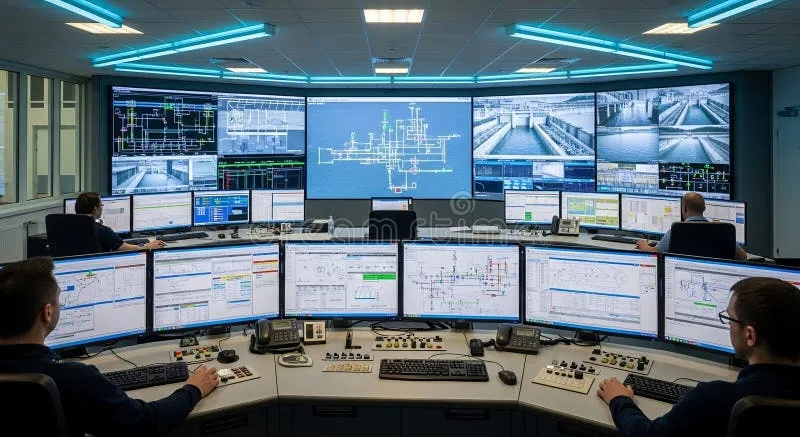
Photo: infrastructure asset management control room monitoring screens data, via thumbs.dreamstime.com
When the Dashboard Goes Dark
In the spring of 2023, a water main beneath a major American city ruptured without warning, flooding streets, disrupting service to tens of thousands of residents, and triggering emergency excavation that cost millions. The utility responsible had an asset management system in place. It had sensors installed along portions of the distribution network. It had years of maintenance records stored in a database. None of it predicted what happened.
This is not an isolated story. From bridge decks to electrical substations, from stormwater culverts to natural gas transmission lines, American infrastructure agencies are discovering an uncomfortable truth: owning the tools for intelligent asset management is not the same as practicing it. The technology has matured. The institutional capacity to use it has not kept pace.
The Integration Problem No One Wants to Fund
At the heart of the failure is a data fragmentation problem that is as much organizational as it is technical. Most large infrastructure agencies operate with asset information scattered across incompatible systems — legacy databases that predate modern software, spreadsheets maintained by individual field crews, inspection reports stored as scanned PDFs, and sensor feeds that pipe data into platforms never designed to communicate with one another.
A 2022 report from the American Society of Civil Engineers noted that while the adoption of asset management frameworks has grown among state and local agencies, the quality and completeness of underlying data remain highly uneven. Without reliable baseline data, even the most sophisticated predictive analytics engine produces outputs that operators distrust — or simply ignore.
The result is a paradox: agencies invest in platforms capable of surfacing early warning indicators, then make operational decisions based on the same inspection schedules and reactive work orders they used a generation ago. The predictive layer exists on paper. In practice, it goes largely unused.
Why Monitoring Technology Underperforms in the Field
There are several compounding reasons why monitoring investments underdeliver. First, procurement cycles often favor acquiring hardware and software licenses over the ongoing staffing and training required to operationalize them. A sensor network installed on an aging bridge generates continuous data — but if no analyst is tasked with interpreting that data, and no protocol exists for escalating anomalies, the stream becomes noise.
Second, the workforce operating these systems is frequently the same workforce navigating retirements, hiring freezes, and skills gaps documented elsewhere in infrastructure management. Data scientists and systems analysts capable of building meaningful predictive models are not typically found in the staffing plans of county highway departments or regional transit authorities.
Third, there is a cultural dimension that resists easy solutions. Many experienced infrastructure managers developed their professional instincts before digital monitoring existed. Trusting an algorithm's assessment of a structure they have personally inspected for decades is not a transition that happens automatically. Without deliberate change management, technology adoption stalls at the point of implementation.
Case Studies in Missed Signals
The I-40 bridge closure over the Mississippi River in 2021 offered a stark illustration of how visual inspection alone can miss what sensor data might catch. A fracture critical crack was discovered during a routine inspection — but the damage had been developing for some time, undetected. The closure stranded commercial traffic across a critical freight corridor for weeks and cost the regional economy hundreds of millions of dollars in disruption.
Similarly, the 2021 partial collapse of a pedestrian bridge in Washington, D.C., raised questions about the interval and methodology of inspections on structures that carry lighter loads and therefore receive less scrutiny than vehicular bridges. In both cases, the infrastructure was not unmonitored — it was monitored through frameworks designed for a different era of risk tolerance.
By contrast, the Metropolitan Transportation Authority in New York has piloted continuous monitoring programs on select bridges and tunnels that integrate sensor data directly into maintenance work order systems. Early results suggest the approach can identify developing anomalies significantly earlier than scheduled inspection cycles would. The challenge is scaling such programs across thousands of assets with constrained budgets.
Data Governance as Infrastructure Policy
Addressing the asset management gap requires treating data governance as a core infrastructure function, not a back-office concern. This means establishing data standards that allow information from different systems and different vendors to be aggregated and analyzed in a unified environment. It means creating dedicated analytical capacity within agencies — or formalizing partnerships with universities and regional planning bodies that can provide it. And it means building procurement frameworks that evaluate technology acquisitions not just on purchase price but on the full lifecycle cost of operating them effectively.
Federal programs such as the Asset Management Plans required under MAP-21 and the FAST Act have pushed state DOTs toward more systematic approaches, but implementation quality varies widely. The Infrastructure Investment and Jobs Act created additional funding streams that could be directed toward closing the data integration gap — but only if agencies prioritize that use over more visible capital expenditures.
Resilience Requires Seeing the System Whole
The deeper lesson of America's asset management struggles is that resilience cannot be built on incomplete information. A bridge that is monitored only at the surface, a pipeline that is inspected only on schedule, a water main whose pressure data lives in a system no one checks — these are not managed assets. They are managed assumptions.
Building infrastructure that endures requires seeing it whole: integrating the physical, the digital, and the institutional into a coherent picture of system health. The technology to do this exists. The governance frameworks to make it actionable are within reach. What remains is the organizational will to close the gap between data collected and knowledge acted upon — before the next silent failure announces itself through catastrophe.